
Frost protection
Frost in the orchard – how anti-frost irrigation and overhead sprinkling help protect plants and crops
Spring frost is one of the greatest threats to modern agriculture and fruit growing. A sudden drop in temperature during the flowering period can destroy crops in a single night, despite months of work throughout the season. That is why frost protection today is not an option, but a necessity. One of the methods that allows plants to be effectively protected against frost is anti-frost irrigation using overhead sprinklers.
In this article, we explain how this method works, when to use it, what its limitations are, and why in many cases it is the most effective method of crop protection.
What is frost and why does it pose a threat to crops?
Frost is a short-term occurrence of temperatures below 0°C, most often in spring. During this time, plants are in the most sensitive stage of development – budding and flowering. Even a slight drop in temperature can cause permanent damage to plants.
In orchards and plantations, the problem is intensified by the fact that air temperature near the ground can be lower than at measurement height. Cold air flows downwards and accumulates in terrain depressions, increasing the risk of losses.
Why are spring frosts so dangerous for plants?
During spring growth, plants develop intensively and their cells contain a large amount of water. When the temperature drops below zero, tissues begin to freeze, which leads to their rupture and death.
As a result, a single spring frost can significantly reduce yield, and in extreme cases destroy it completely. For this reason, protecting orchards against frost is a key element of risk management in fruit production.
What does anti-frost irrigation involve?
Anti-frost irrigation is an active protection method that involves the controlled application of water to plants during frost events. Its effectiveness is based on a physical phenomenon, namely the change of the state of aggregation of water.
During the freezing of 1 liter of water, approximately 80 kcal of heat is released, which allows the temperature of plant tissues to be maintained close to zero, even when the surrounding environment is colder. Thanks to this, effective protection of plants against frost is possible.
How does overhead sprinkling work?
Overhead sprinkling consists of evenly applying water from above, directly onto the canopy of trees or shrubs. The water freezes on the surface of the plants and forms a layer of ice, which acts as an insulating barrier.
Crucially, overhead sprinkling involves the continuous supply of water until the temperature rises. Interrupting the process causes a rapid release of heat from plant tissues, which can exacerbate damage.
When should anti-frost sprinkling be started?
The system should be activated when the temperature drops to around 0°C, before negative temperatures occur. If the temperature falls below zero and sprinkling has not been started, the risk of damage increases significantly.
The decision to start should be based on local measurements rather than forecasts alone, as microclimatic conditions in the orchard can vary considerably.
Why must sprinkling not be interrupted?
One of the most common mistakes is switching the system off too early. When ice begins to melt and then refreezes without a supply of water, it absorbs heat from the crop, leading to losses.
Therefore, sprinkling should be continued until the ice has completely thawed. Only then is it possible to maintain effective protection.
Overhead sprinkling or anti-frost fogging?
There are many crop protection solutions available, but their effectiveness varies. Overhead sprinkling and anti-frost fogging are the two most commonly used active methods.
Fogging creates a layer of mist that limits heat radiation and mainly protects plants against radiative frosts. In practice, however, overhead sprinkling is considered the more universal solution, effective also in the case of advective frosts.
How to design an anti-frost installation?
A properly designed anti-frost installation consists of a network of pipelines, a water source and appropriately selected sprinklers. The number of devices required depends on the area and shape of the plantation and the range of water application to the plants.
A
well-designed irrigation system is also perfectly suited for standard
irrigation during periods of drought.
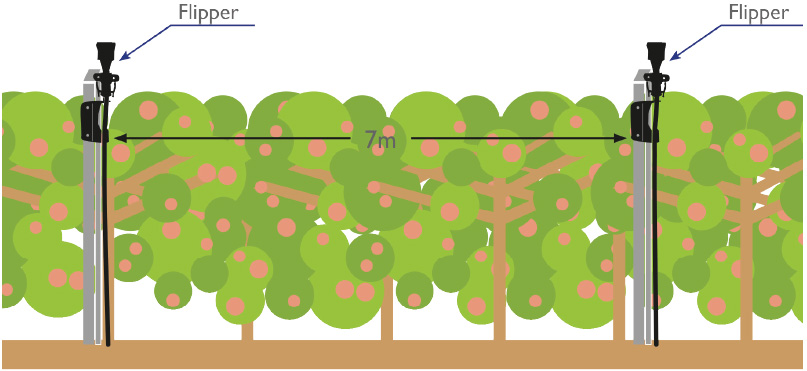
Example of a Flipper sprinkler installation in an orchard. Spacing 7 × 3 m, water consumption 16.16 m³/ha/h
Water consumption and cost-effectiveness
One of the arguments against overhead sprinkling is water consumption. For the system to work effectively, it must supply water continuously throughout the duration of the frost event, which increases water demand.
In practice, however, water consumption is far less costly than crop loss. A well-designed system represents a relatively low cost compared to potential losses.
Protection of orchards and berry plantations
In fruit production, especially in crops such as apple trees or blueberries, frosts are one of the main risk factors. Therefore, the orchard character of these crops requires solutions that act quickly and effectively.
Protecting an orchard against spring frosts using overhead sprinkling makes it possible to stabilize temperature and limit losses even under difficult conditions.
Proven solutions for frost protection
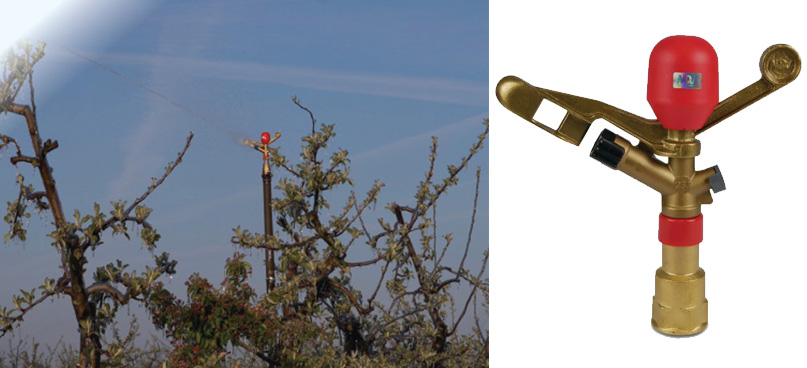
NaanDanJain 233B overhead sprinkler
Brass 233B
overhead sprinklers offer reliable protection of orchards against frost. The
red cap protects the spring against freezing, and a range of up to 20 m enables
even coverage of large areas. This is a durable solution, resistant to
contamination and adapted to harsh conditions.
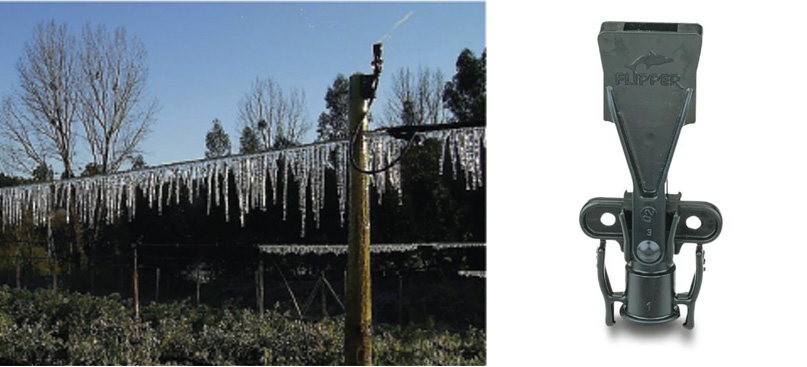
Flipper sprinkler – water savings
Flipper is
a sprinkler designed for vineyards and fruit walls. Large droplets reduce the
cooling effect at system start-up, and water savings reach up to 70%. The device operates safely at temperatures
down to -10°C.
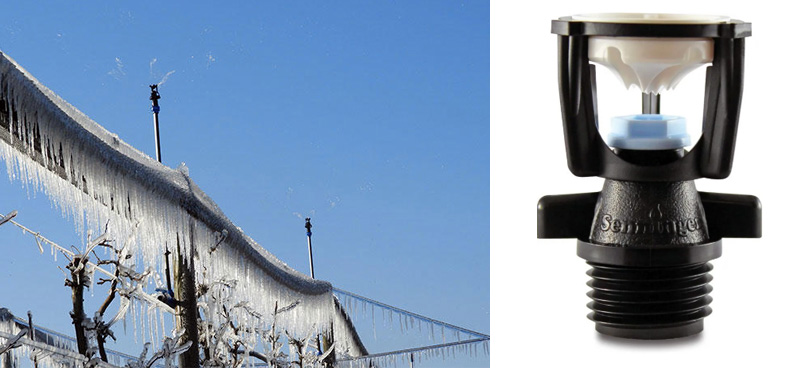
Wobbler
sprinklers provide even water distribution over 360°, operate at low pressure
and are wind-resistant, making them effective in protecting plantations against
frost.
FAQ – anti-frost irrigation
When should anti-frost irrigation be started?
Sprinkling should be started when the temperature drops below 0°C and continued until the temperature rises above zero.How much water does overhead sprinkling consume?
Consumption depends on the system, but on average ranges from 20 to 50 m³/h/ha.Does overhead sprinkling work only in orchards?
No, this method is also effective in vegetable, ornamental and berry crops.Does wind affect system effectiveness?
Yes, at wind speeds above 5 m/s, the effectiveness of sprinkling decreases.