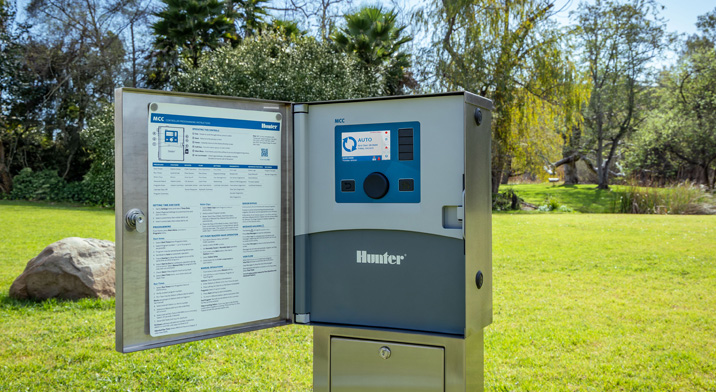
Hunter MCC: Smart commercial controller without the premium price
27 Mar 2026, 12:00:00
Hunter's new mid-range controller fills the gap between the ICC2 and ACC2 — giving installers up to 108 stations, three wiring technologies, real-time flow monitoring, and full Centralus cloud connectivity.
Why the Hunter MCC controller exists
If you regularly specify controllers for medium to large commercial irrigation projects, you'll recognise the dilemma: the ICC2 is a solid, cost-effective controller, but its 54-station ceiling and limited simultaneous station capacity make it a poor fit for bigger sites. The ACC2 is a fully-featured commercial powerhouse — but for many projects it's more controller than the budget can justify.
The Hunter MCC (Mid Commercial Controller) is Hunter's answer to that gap. It brings the operating logic and interface of the ACC2 together with the proven internal hardware of the ICC2, delivering a controller that scales to 108 stations, supports all three of Hunter's output technologies simultaneously, includes advanced flow monitoring, and connects to the Centralus cloud platform — at a price point that makes sense for the majority of commercial projects.
The short version
The MCC is the right commercial irrigation controller when the ICC2 runs out of capacity but the ACC2 is more than the project needs — covering sports fields, large parks, golf course peripheral areas, municipal green spaces, and larger private estates.
Three wiring technologies, one controller
One of the MCC's real strengths in the field is its flexibility around output types. It supports conventional wiring, EZDS two-wire decoder systems, and Wireless Valve Link outputs — and these can be used simultaneously in any combination, up to 108 stations total (54 maximum for conventional wiring alone). That means you can work with the infrastructure already on site rather than redesigning it around the controller.
With Wireless Valve Link, you get wide-area wireless coverage with support for multiple repeaters, which is a significant advantage on large open sites like sports fields, golf courses, or parks where trenching for additional cable isn't practical.
Flow monitoring that actually manages flow
The MCC includes advanced flow monitoring and management for up to 3 flow zones, with up to 3 flow sensor inputs. This goes beyond basic leak detection — the controller learns the expected flow for each zone, monitors in real time during automatic irrigation, and can automatically identify and shut down a faulty station when incorrect flows are detected. Flow totals are stored in controller memory, giving you a running record of system water usage.
For larger sites with multiple zones and water budgeting requirements, this is a meaningful capability to have built in.
16 programs, 10 start times, 8 simultaneous stations
The programming depth of the MCC reflects its commercial intent. It offers 16 independent programs, 10 start times per program, and the ability to run up to 8 stations simultaneously — a significant step up from the ICC2's 2 simultaneous stations. Three pump/master valve outputs at 800 mA each provide solid control over pressurised systems.
Useful scheduling tools include Cycle and Soak (automatically dividing run times to prevent runoff), Non-Water Days, Solar Sync™ compatibility for ET-based weather adjustment, and Conditional Response — which allows sensor inputs to trigger pre-programmed actions, such as switching water sources or starting specialty programs automatically.
Remote control and cloud connectivity
The MCC uses the same communication modules as the ACC2, which matters in practice: it means you're stocking the same Wi-Fi, LAN, and cellular modules across both controller families. For connected sites, it integrates with Centralus™ Irrigation Management Platform for full remote monitoring and scheduling, and is also compatible with Hunter 360 Software and third-party SCADA and automation systems.
For on-site remote operation, the ROAM LR long-range remote is supported — useful for manual operation and diagnostics on large sites without walking back to the controller.
MCC vs ICC2 vs ACC2: full comparison
The table below summarises the key differences between Hunter's main commercial controller families to help with specification.
| Feature | ICC2 | MCC | ACC2 |
|---|---|---|---|
| Max stations | 54 | 108 (54 conv.) | 54 conv. /225 decoder |
| Programs | 4 | 16 | 32 |
| Start times | 8 | 10 | 10 |
| Simultaneous stations | 2 + P/MV | 8 +3 P/MV | 14-20+ + P/MV |
| Conventional output | Ok | Ok | Ok |
| EZDS two-wire output | Ok | Ok | - (ICD decoder) |
| Wireless valve link | Ok | Ok | - |
| Flow monitoring | Ok (basic) | Ok - up to 3 zones | Ok - up to 6 zones |
| Flow management | - | Ok - up to 3 zones | Ok - up to 6 zones |
| Centralus compatible | Ok | Ok (same modules) | Ok |
| Solar sync compatible | Ok | Ok | Ok |
| Conditional response | - | Ok | Ok |
| Pump/MV outputs | 1 | 3*800 mA | 3 - 6 |
| Warranty | 5 years | 5 years | 5 years |
Frequently Asked Questions (FAQ)
What is the maximum number of stations the Hunter MCC can control?
The MCC supports up to 108 stations total, depending on the mix of wiring types. Conventional wiring alone supports up to 54 stations.
Can the MCC use both wired and wireless irrigation valves?
Yes. One of its key advantages is the ability to combine conventional wiring, two-wire decoder systems, and Wireless Valve Link in a single system.
Is the Hunter MCC suitable for large commercial projects?
Absolutely. It’s designed for mid-to-large commercial irrigation systems, including parks, sports fields, and municipal landscapes — especially where ACC2 would be excessive.
What is the difference between the Hunter MCC and the ACC2?
The MCC supports up to 108 stations (54 conventional) with up to 3 flow zones and 16 programs. The ACC2 supports up to 54 conventional or 75–225 decoder stations, up to 6 flow zones, and 32 programs. The MCC is priced lower and shares the same Centralus communication modules as the ACC2, making it straightforward to manage both in the same installation fleet.
What is the difference between the Hunter MCC and the ICC2?
The MCC offers significantly more programming depth: 16 programs vs 4, 10 start times per program vs 8, and up to 8 simultaneous stations vs 2. It adds advanced flow management (not available on the ICC2), 3 pump/master valve outputs vs 1, and expands to 108 stations vs 54. Both support the same three output technologies.